common named class. More...
#include <zeda/zeda_misc.h>
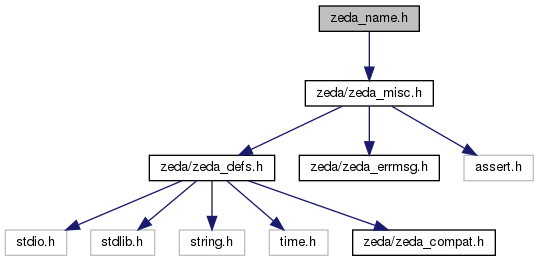
Include dependency graph for zeda_name.h:
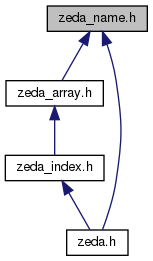
This graph shows which files directly or indirectly include this file:
Go to the source code of this file.
Macros | |
| #define | Z_NAMED_CLASS char *name; |
| an inheritance of named class. More... | |
| #define | ZNONAME "noname" |
| the default name for no-name. More... | |
| #define | zNamePtr(c) (c)->name |
| #define | zNameSetPtr(c, p) ( (c)->name = (p) ) |
| #define | zName(c) ( (c) && zNamePtr(c) ? zNamePtr(c) : ZNONAME ) |
| #define | zNameSet(c, n) zNameSetPtr( c, zStrClone(n) ) |
| #define | zNameFree(c) zFree( zNamePtr(c) ) |
| #define | zNameFind(array, n, name, ptr) |
Detailed Description
common named class.
Macro Definition Documentation
◆ Z_NAMED_CLASS
| #define Z_NAMED_CLASS char *name; |
an inheritance of named class.
Z_NAMED_CLASS macro works as a keyword to inherit a named class, namely, a class which can be identified by a string.
The inheritance can have a string to represent its name, which is referred by zName(). Use zNameSet() to set the name. Use zNameFree() to free the name string.
When searching an instance with a name name from an array of the class, call zNameFind( array, n, name, ptr ); where array is the pointer to array, n is the size of the array, name is a string to be referred, and ptr is a pointer to the element found. If it fails to find a corresponding element, the null pointer set for ptr.
◆ ZNONAME
| #define ZNONAME "noname" |
the default name for no-name.
◆ zNamePtr
| #define zNamePtr | ( | c | ) | (c)->name |
◆ zNameSetPtr
| #define zNameSetPtr | ( | c, | |
| p | |||
| ) | ( (c)->name = (p) ) |
◆ zName
◆ zNameSet
| #define zNameSet | ( | c, | |
| n | |||
| ) | zNameSetPtr( c, zStrClone(n) ) |
◆ zNameFree
◆ zNameFind
| #define zNameFind | ( | array, | |
| n, | |||
| name, | |||
| ptr | |||
| ) |
Value:
do{\
int __z_name_find_id;\
(ptr) = NULL;\
if( (name) != NULL && strcmp( (name), ZNONAME ) && (array) != NULL )\
for( __z_name_find_id=0; __z_name_find_id<(n); __z_name_find_id++ )\
if( zNamePtr( &(array)[__z_name_find_id] ) &&\
!strcmp( (name), zName( (&(array)[__z_name_find_id]) ) ) ){\
(ptr) = &(array)[__z_name_find_id];\
break;\
}\
} while(0)